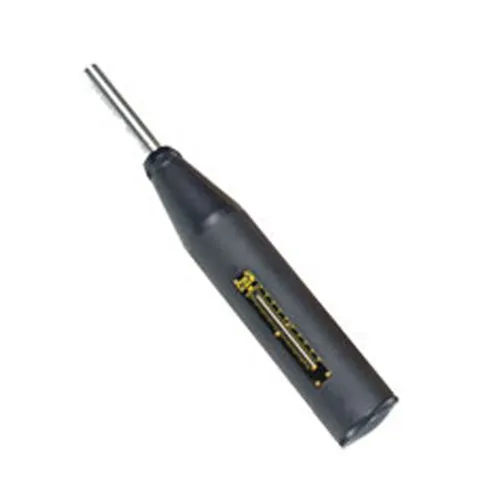
Manual Rebound Hammer
Manual Test Hammers provide the most economical, quick and easy concrete compressive strength test in the field. It will also provide an indices of hardness and compressive strength for other construction materials. Conforms to ASTM C-805 and other International Standards.

- Manual hammers for the quick and easy determination of the strength of concrete.
- Easy to use manual calculation of the mean rebound number.
All James Test Hammers conform to:
| ASTM C-805 | USA |
| ASTM D-5873 | USA |
| BS 1881-202 | Grt. Brit. |
| ISO/DIS 8045 | Intl. |
| EN 12 504-2 | Europe |
| ENV 206 | Europe |
| NFP 18-417 | France |
| B 15-225 | Belgium |
| JGJ/T 23-2001 | China |
| JJG 817-1993 | China |
The W-M-250 Manual Test Hammer is the traditional instrument used for the non-destructive testing of hardened concrete. This easy-to-use instrument provides a quick and simple test for obtaining an immediate indication of concrete strength in various parts of a structure. The minimum verifiable strength is 1400 PSI (10 MPa) to approximately 9000 PSI (62 MPa). All concrete test hammers measure the surface hardness of the material they are testing; this is then correlated to concrete compressive strength.
The manual concrete test hammer, aka rebound hammer, schmidt hammer, swiss hammer, sclerometer, is the most widely used non destructive instrument for compressive strength determination. However, it typically has the largest coefficient of variation; therefore its result should be verified with another non destructive test such as the V-Meter MK III.
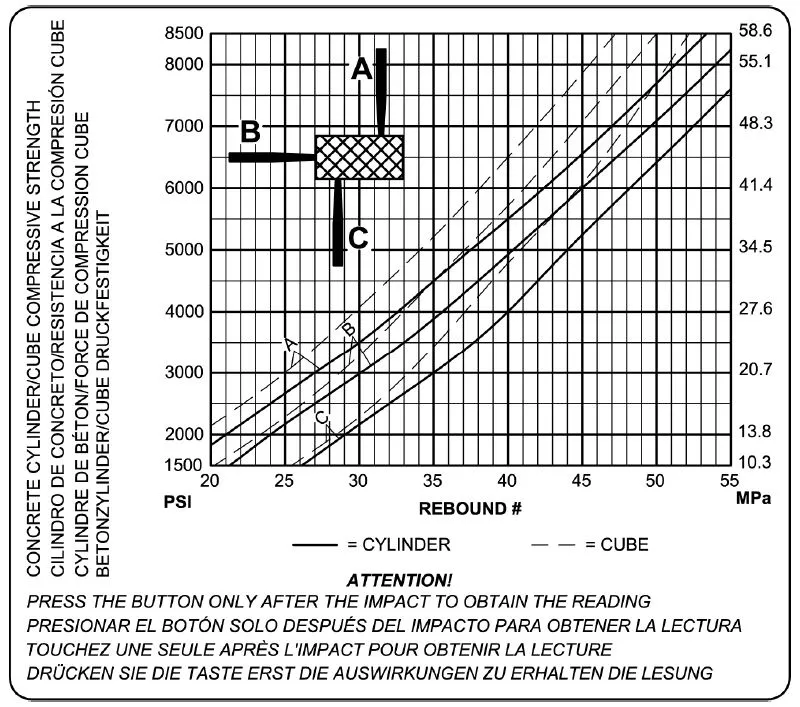
Typical Correlation Charts for James Instruments Rebound Hammer:
| Impact Energy: | 2.2 Nm (1.6 lbf-ft) |
| Weight: | 6 lbs. (2.7 kg) |
| Size: | 5 in. x 3 in. x 14 in. (127 x 76 x 355 mm) |
| Shipping Weight: | 6 lbs. (2.7 kg) |
| Carrying Case: | 15.5 x 11.5 in. x 2.5 in. (394 x 292 x 64 mm) |
| Dimensions: | 8 in. x 7 in. x 14 in. (203 x 178 x 355 mm) |
Help me choose the right product...