James Bond Test™ MK IV
Determine the adhesion strength of shotcrete, epoxies, paint, asphalt and other repair materials or coatings. Includes 10 - 2" Discs.
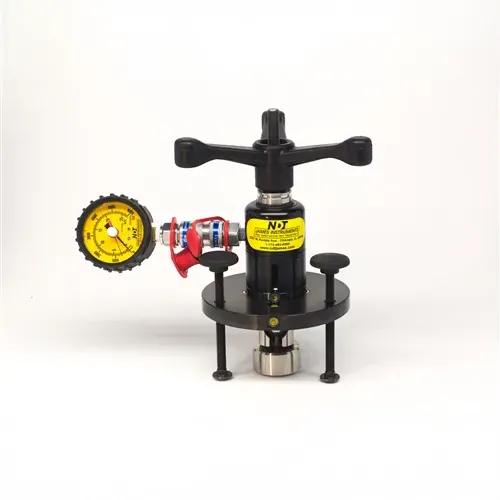
The James Bond Tester™ MK IV or pull off adhesion test measures the bond strength or tensile strength of concrete, asphalt, tile, concrete repair, or other overlay material by the direct tension or pull off method. By pulling a 50 mm (2 inch) steel disk attached to the material under the unit can,
- Measure the near surface strength of a substrate in order to determine the substrates quality before applying an overlay
- Determine the bond strength of a repair or overlay material after it is applied to the substrate
- Determine the tensile strength of a repair, overlay or adhesive after the material is applied to the surface
The James Bond Tester™ MK IV has been successfully used to verify the quality of existing materials, determine the adhesion strength of shotcrete, tile, epoxies, paint and other repair materials or coatings.
- Accurate bond strength of repair mortars, epoxy resins, laminates, overlays, and other coatings.
- Calibrated gauge with maximum load indicator and mechanical damping.
- Ball Joint Design for rapid testing as well as assuring direct tensile loading
- Adjustable alignment plate with built in leveling facility for both vertical and horizontal pulls.
- Compact design.
- Easy to use.
Standards
- ISO 4624 Paints and varnishes -- Pull-off test for adhesion
- EN 1015-12 Methods of test for mortar for masonry. Determination of adhesive strength of hardened rendering and plastering mortars on substrate
- EN 1348 Determination of Tensile Adhesion Strength for Cementitious Adhesives
- BS 1881 Part 207 Testing concrete. Recommendations for the assessment of concrete strength by near-to-surface tests
- ASTM C 1583 Standard Test Method for Tensile Strength of Concrete Surfaces and the Bond Strength or Tensile Strength of Concrete Repair and Overlay Materials by Direct Tension (Pull-off Method)
- ASTM D 4541 Standard Test Method for Pull-Off Strength of Coatings Using Portable Adhesion Testers
- ACI 548-30 Guide for the Application of Epoxy and Latex Adhesives for Bonding Freshly Mixed and Hardened Concretes
- DIN 1048 Part 2 Testing concrete; testing of hardened concrete (specimens taken in situ)
- ASTM D 7234 Standard Test Method for Pull-Off Adhesion Strength of Coatings on Concrete Using Portable Pull-Off Adhesion Testers
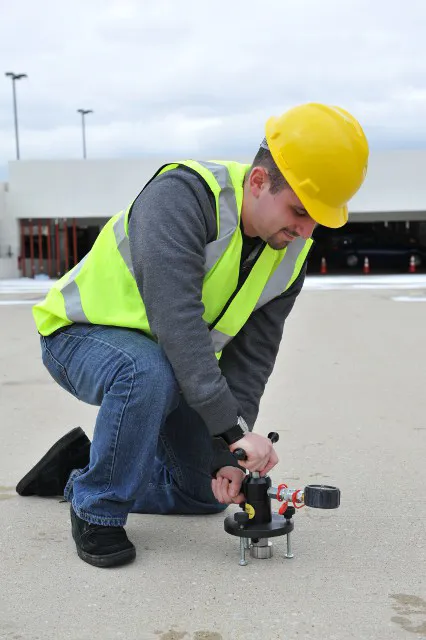
- ASTM D 7234-21 Standard Test Method for Pull-Off Adhesion Strength of Coatings on Concrete Using Portable Pull-Off Adhesion Testers
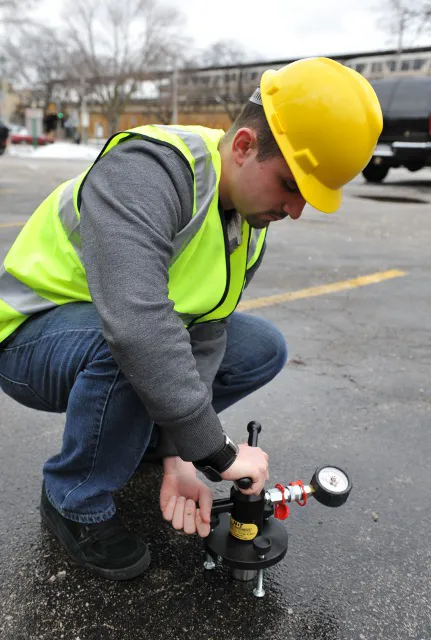
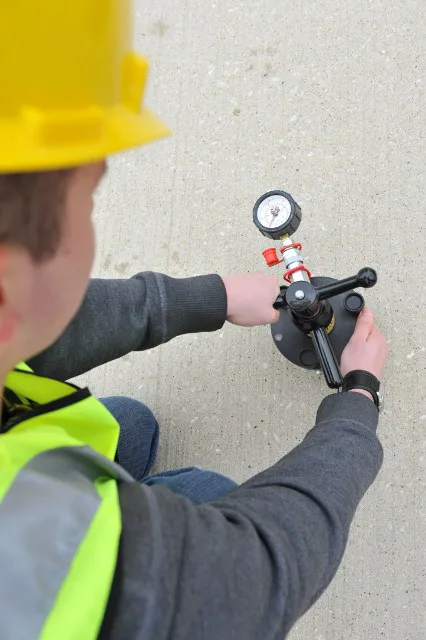
James Bond Tester™ MK IV on Horizontal Concrete Deck
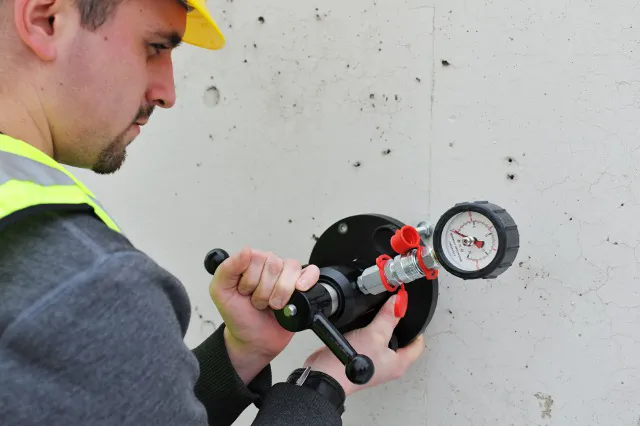
James Bond Tester™ MK IV on Vertical Concrete Repair
James Bond Tester™ MK IV on Asphalt
Adequate direct tensile strength between two layers is important if repairs to concrete structures or additional overlays on existing concrete are to be structurally sound. The James Bond Tester™ MK IV involves bonding a circular steel disk to the surface by means of an epoxy resin adhesive. A controlled tensile force is then applied to the disk and failure will occur at the weakest point: either in the host material, or in the bond between overlay and host material.
James Bond Tester™ MK IV Showing Operator View while Testing
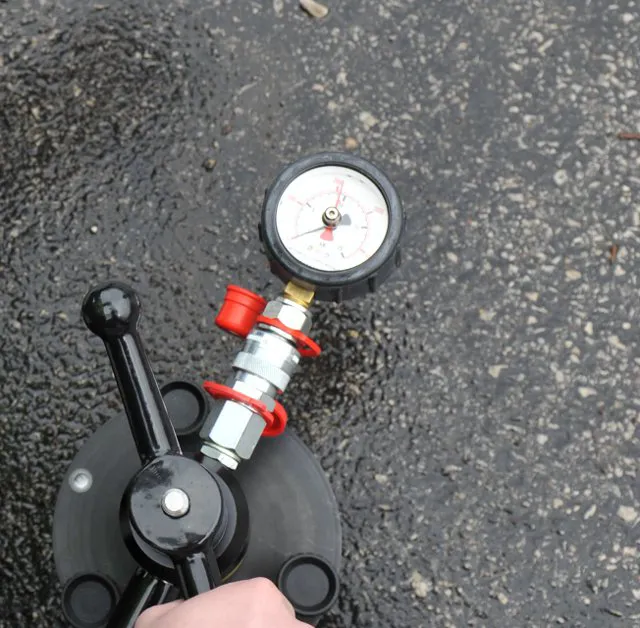
James Bond Tester™ MK IV gauge showing maximum load indicator.
Easy to read gauges facilitate performing the test. Two gau ges are supplied with each system. One for lower strength ranges, weaker concrete, painted on overlays, etc. The other for higher strength overlays, and concrete, mortar and asphalt repairs. These gauges feature
- Rubberized Rugged Outer Housing
- Quick Disconnect for Rapid Setup
- Maximum Load Indicator
- Mechanical Damping to Minimize Test Error
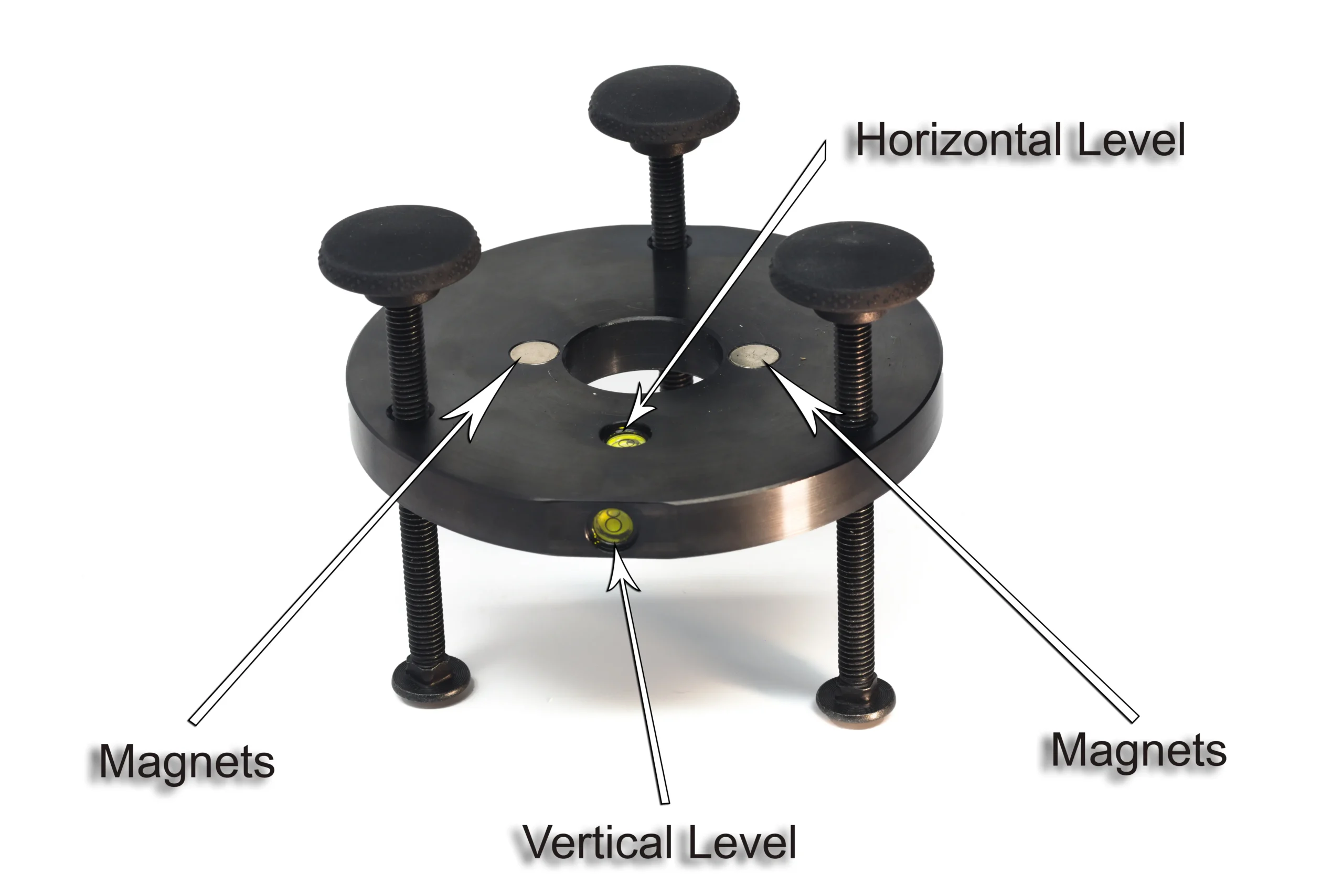
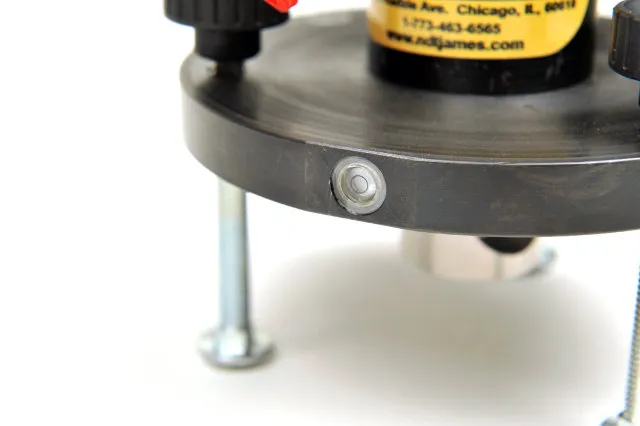
Alignment Plate showing both horizontal and vertical levels
Alignment plate showing vertical level detail
The alignment plate has two 360 degree bubble levels built in to facilitate set up, allowing a direct tensile pull from the surface of the material under test. The level can be easily adjusted by utilizing the thumb screws attached to the adjustment legs.
There are also two magnets that hold the pull assembly to the plate. This eliminates the tedious need for screws to keep the two assemblies together when transporting the system from one test to another. Yet it still keeps the system compact for storage and transportation.
James Bond Tester™ MK IV Core Diagram
Core Indicating Failure at the Bond Between the Overlay and Substrate
For Proper testing, it is first necessary to cut through the overly under test directly to the substrate underneath. In the case of paints, thin coatings and overlays this can simply be accomplished with a fine exacto knife or similar sharp tool. In the case of concrete overlays, asphalts, tiles or similar repair mortars this can only be accomplished by coring saw or drill.
Failure can typically occur in either one of three modes:
- in substrate
- at the substrate overlay interface
- in the overlay.
Tests can also be performed for verification purposes and not to failure. This will assure the engineer that both the overlay and substrate have 'bonded' and further work or use can proceed.
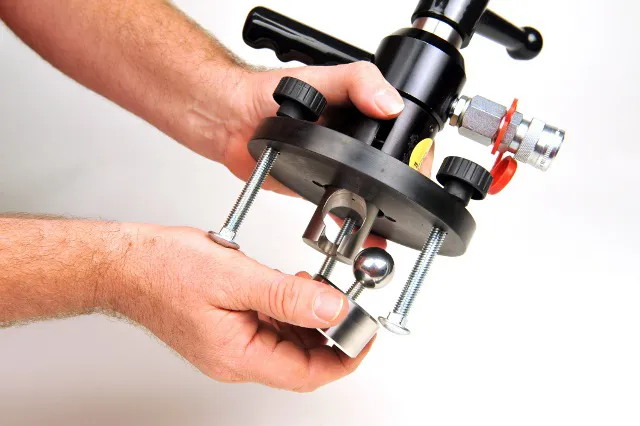
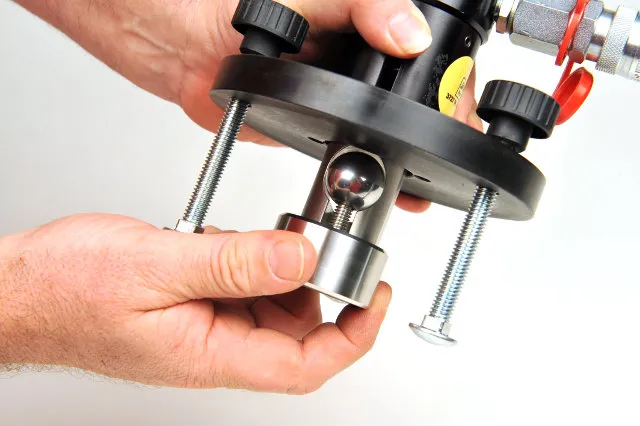
James Bond Tester™ MK IV Pull Disk Being Mounted in Puller Assembly
Pull Disk Mounted in Bond Puller Assembly
James Bond Tester™ MK IV features a ball joint pull disk design. This assures that the pulling force is always in tension even if the pull disk is uneven due to irregularities in the overlay surface. This also creates a rapid test setup as the ball end of the disk simply slide into the Bond Test Puller.
| Gauge Specifications | ||||
| Range | Increments | Maximum Load Indicator | Mechanical Dampened Movement | Diameter |
| 0 - 9 kN / 0 - 2000 lbf | 0.2 kN | Yes | Yes | 70 mm / 2.5 in. |
| 0 - 25 kN / 0 - 6000 lbf | 0.5 kN / 200 lbf | Yes | Yes | 70 mm / 2.5 in. |
| Gauge Specifications | ||||
| Range | Increments | Maximum Load Indicator | Mechanical Dampened Movement | Diameter |
| 0 - 9 kN / 0 - 2000 lbf | 0.2 kN | Yes | Yes | 70 mm / 2.5 in. |
| 0 - 25 kN / 0 - 6000 lbf | 0.5 kN / 200 lbf | Yes | Yes | 70 mm / 2.5 in. |
| Bond Test Puller Assembly | ||
| Diameter | Height | Maximum Load |
| 60 mm / 2.5 in. | 210 mm / 8.125 in. | 30 kN / 6675 lbf |
| Bond Test Assembly (Alignment Plate Attached to Bond Test Puller Assembly) | ||
| Height | Width | Weight |
| 240 mm / 9.375 in. | 310 mm / 12.5 in. | 5 kg / 11 lbs. |
| James Bond Tester™ MK IV in Case | |||
| Height | Width | Depth | Weight |
| 410 mm / 16 in. | 508 mm / 20 in. | 205 mm / 8 in. | 14 kg / 31 lbs. |
The Epoxy may have been mixed with unequal parts of Resin & Hardener; causing it to not cure fully. Also, the temperature may be too cold for the epoxy to harden. Thus, more time or a higher temperature is needed for the epoxy to cure.
Surface may not have been cleaned properly. A good indication of this would be little bits of concrete stuck to the bottom of the disk. You may also not have a level surface.
Yes and no. Make sure you follow the specs for each job you do, some may want you to take it failure, while others may want you to just take it to a certain strength.
Chances are you need to fill the puller with oil.
You need just a thin layer, about 3 for 4 sheets of paper.
Help me choose the right product...